 Communal language
Strengthens collaboration and a sense of community
Use communal words to signal you value an environment where everyone can get involved and thrive.
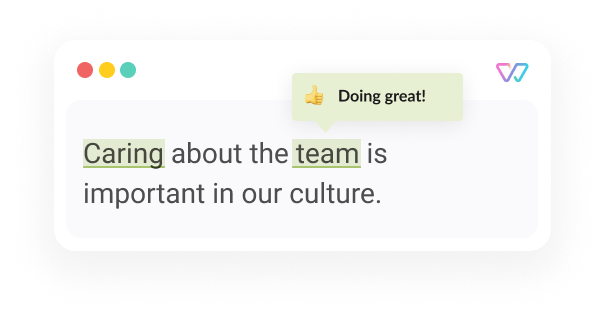
👍
Our sales and online-marketing teams have been working together closely coordinating their efforts to reach our shared milestones for more inclusive and multiculturally aware product communication in the first quarter.👎
Sales and online-marketing have joined forces to reach our Q1 goals for more inclusive and multiculturally aware product communication.Dig deeper
Women, Generation Z, and team-oriented professionals gravitate toward companies that reach out with communal communication. Studies show job ads using communal words can attract 42% more applications from women than ads that use agentic words without deterring male applicants.
Agentic words are the counterparts of communal words. They are linked to a permissive culture accepting of a mindset that values action more than thought. In essence, “act now, ask for forgiveness later.” Recent data shows this may be bad business advice. Organizations with mission statements prioritizing careful evaluation – likely to involve a joint effort – over fast action are less likely to see disciplinary action for workplace discrimination.
Companies emphasizing community and mutual respect in their communications face fewer reputational risks. And there is evidence that suggests that language that frames employee distress as a collective concern rather than an individual problem, strengthens connectedness and employee wellbeing
Companies emphasizing community and mutual respect in their communications face fewer reputational risks. And there is evidence that language framing employee distress as a collective concern rather than an individual problem, strengthens connectedness and employee wellbeing.
Communal wording is critical not only in building an inclusive workplace climate but a safer environment, too. A 2018 report on sexual harassment in academia summarizes, “Organizational climate is the single most important factor in determining whether sexual harassment is likely to occur in a work setting.”
Shout-outs
- Research: Organizations That Move Fast Really Do Break Things (Dana Kanze, Mark A. Conley, and E. Tory Higgins)
- The motivation of mission statements: How regulatory mode influences workplace discrimination (Dana Kanze, Mark A. Conley, E. Tory Higgins)
- Stop Framing Wellness Programs Around Self-Care (Michelle A. Barton, Bill Kahn, Sally Maitlis, and Kathleen M. Sutcliffe)
- Social Relationships and Mortality Risk: A Meta-analytic Review (J Holt-Lunstad, TB Smith, JB Layton)
- Sexual Harassment of Women: Climate, Culture, and Consequences in Academic Sciences, Engineering, and Medicine. A Consensus Study Report. (Paula A. Johnson, Sheila E. Widnall, and Frazier F. Benya, Editors Committee on the Impacts of Sexual Harassment in Academia Committee on Women in Science, Engineering, and Medicine Policy and Global Affairs)
In other words