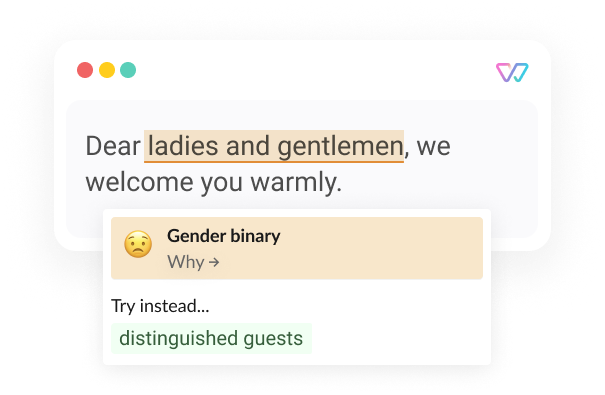
 Gender binary
Enforces the traditional binary form of gender
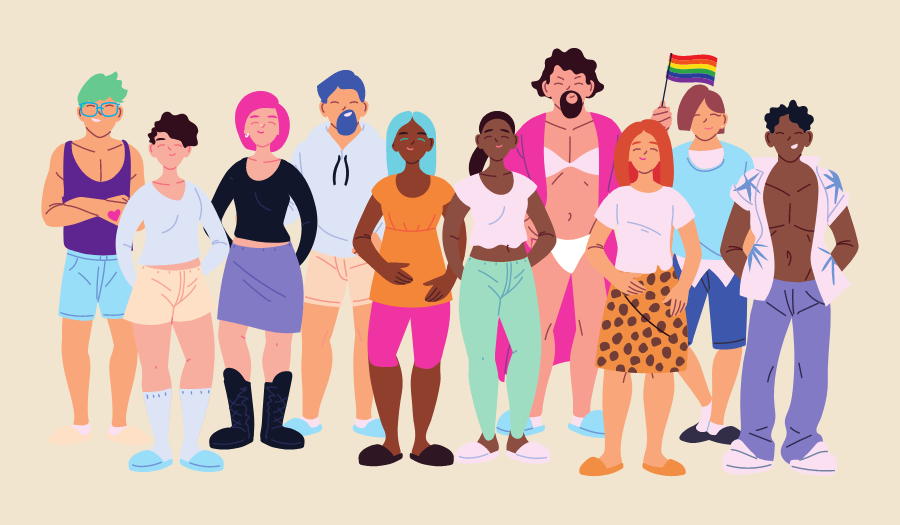
To welcome people of all genders, avoid limiting people to traditional gender roles, gender identities, and gender expressions.
Basic Example
Advanced Example
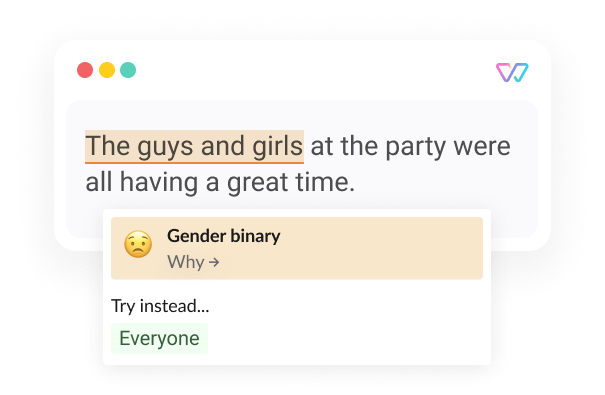
From baby colors to family roles to segregated bathrooms, the idea of a two-gender world touches every aspect of society. We are taught to presume a gender based on biology. Once assigned, this gender becomes part of who we are to others. It sets expectations: how to look, how to behave, and who to love. And it stays - for life.
But our understanding of the gender spectrum is growing in leaps and bounds. Society is changing. Help all gender identities feel safe and free to express themselves. Share your pronouns. And ask yourself, "What would I write if this person wasn’t a specific gender?"
👍
Hello everyone, We're thrilled to announce the highlight of this year's fundraiser: an auction featuring high-end masculine apparel donated by a local fashion creative.
👎
Ladies and gentlemen, We're thrilled to announce the highlight of this year's fundraiser: an auction featuring high-end men's wear donated by a local fashion designer.Doesn't resonate with
- The generation born between the mid-to-late 1990s and early 2010s
- People who feel their gender cannot be defined as either a man or woman
- People in the LGBTQIA+ community
Dig deeper
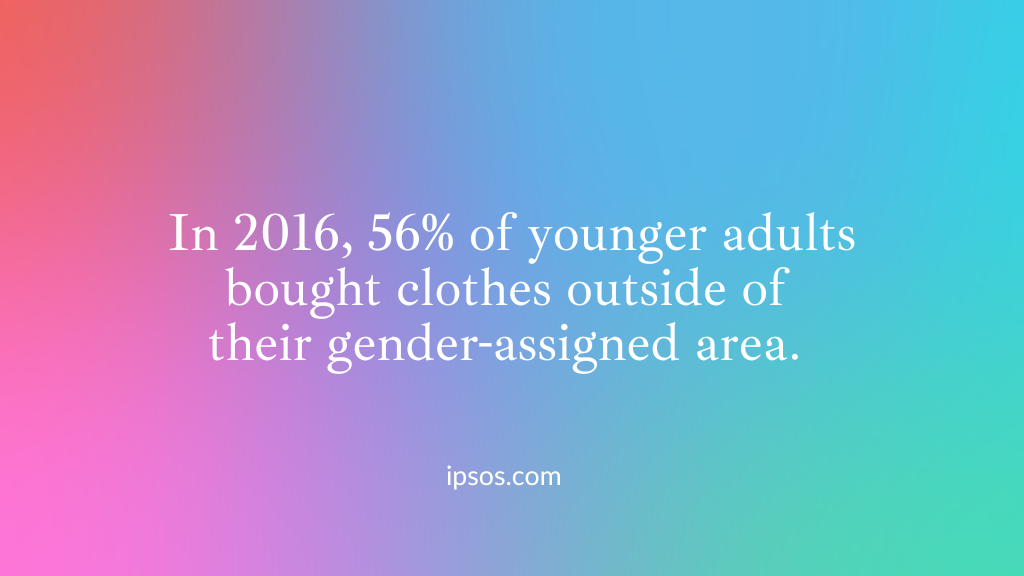
The gender binary is a social and cultural construct. It classifies all people into one of two genders - female or male. These genders are assigned at birth based on a child's biological sex. Societal norms set gender-specific expectations for looks, clothing, and behavior. They determine how a gender should move and speak, their role in public and in private, and the gender they should feel attracted to. Non-conforming gender identities and expressions are noted – and judged, even penalized.
The gender binary ignores the complex reality of gender. A person's internal sense of their gender can change, not only throughout their life but throughout the day. A person may feel their body, assigned cisgender, or social gender does not reflect how they themself identify, express, or experience their gender.
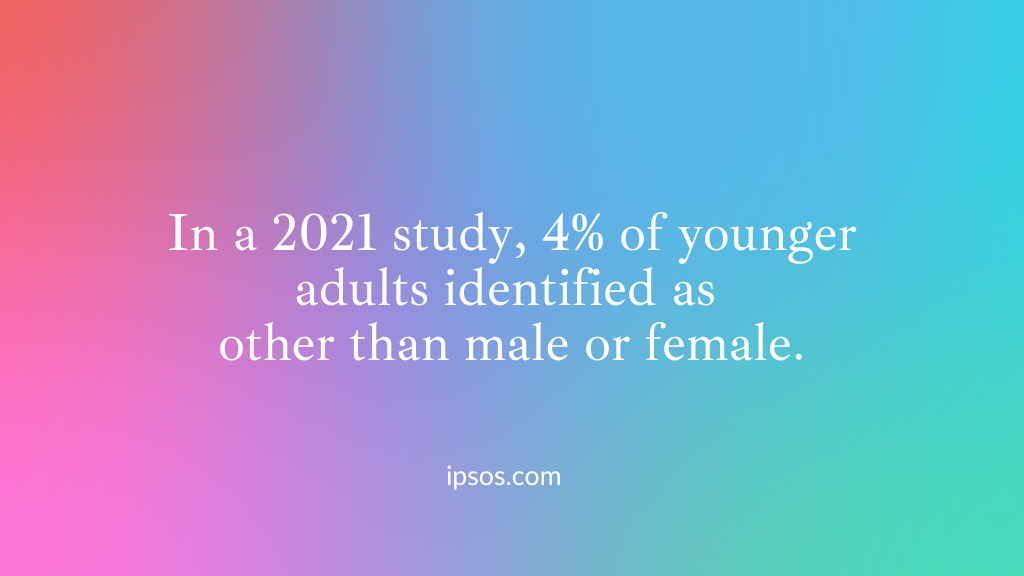
The more we learn about gender, the less we know. It's younger generations who raise awareness of gender diversity. Younger people are more accepting of gender identities beyond the binary. They're more likely to experience their own gender as fluid. And Gen Z are starting to reshape the workplace. Studies indicate, they expect future employers to share their values and reflect their diversity. And that includes gender identities.
Shout-outs
- Hidden but Widespread Gender Biases Emerge in Millions of Words (Tessa Charlesworth)
- Language influences mass opinion toward gender and LGBT equality (Margit Tavits and Efrén O. Pérez)
- Gen Z goes beyond gender binaries in new Innovation Group data (Shepherd Laughlin)
- Biological Sex and Gender in the United States (Risa Aria Schnebly)
- Understanding Gender (Gender Spectrum)
- Gen Z Grads Are Heading To Work. Here Are Three Ways Companies Can Attract And Retain Women. (Christine Y. Cruzvergara)
In other words